Blog
NELK
Mobility and Belonging through the Global Novel and the Border Regime - representations that matter
Nadia Butt - Mobility, Migration, Modernity: The Global Novel and Its Theory

Nadia Butt
Mobility, Migration, Modernity: The Global Novel and Its Theory
This lecture provides the theoretical frames of the global novel in the twenty-first century. Drawing upon existing research on the global novel in relation to world literature, postcolonial literature, diasporic literature, transcultural or transnational literature, the aim is to define the global novel from the perspective of global change, modernity, mass migration and mobility, the realities of which have fundamentally shaped the form and content of the novel today. My contention is that the global novel can be theorised in three major ways: First, how it reveals the outcome of travel, mobility, and migration; second, how the experience of displacement and exile are often essential to the global novel third, how the global novel unfolds the challenges of the diasporic condition. To this end, I will allude to a significant number of novels from the Global South, which can be read from the theoretical framework presented in the lecture.
Veranstalter*in:
Cornelia Goethe Centrum
In Kooperation mit:
GRADE Center Gender
Goethe-Universität Frankfurt am Main
Please find more info here.
TEFL

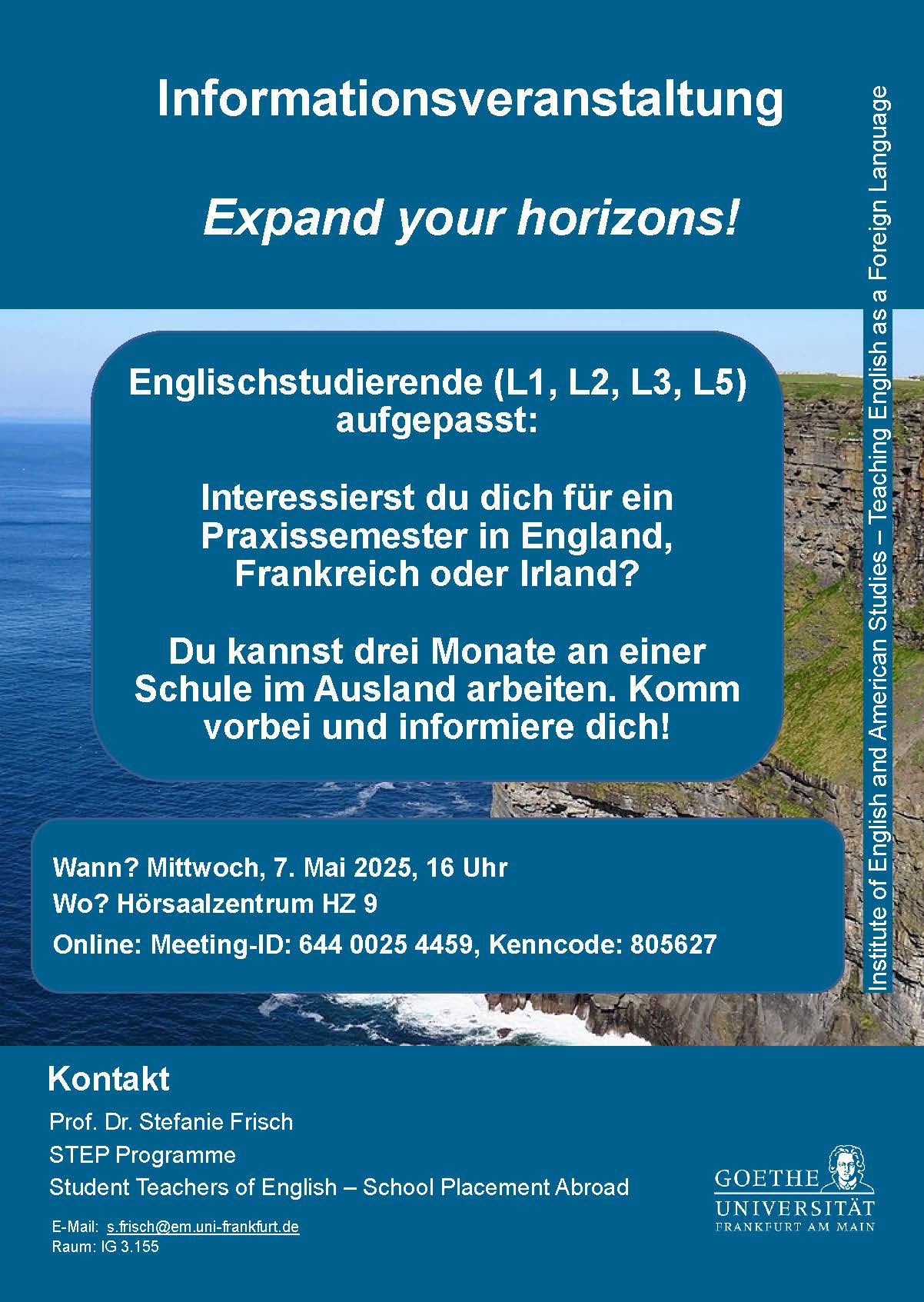
Das „Sprachstadtprojekt“ zwischen der IEAS und der Weißfrauenschule ist mittlerweile schon Tradition: Jedes Jahr organisieren Studierende des Lehramts Englisch einen Sprachentag für Schüler*innen mit Rechtsanspruch auf Förderung im Bereich Sprachheilförderung. Am 7. Mai hieß die Weißfrauenschule die Seminargruppe willkommen, damit sich die Studierenden selber ein Bild von der Schule machen konnten, und die „Sprachstädter*innen“ in Klasse 3 und 4 kennenlernen konnten. Die gemachten Beobachtungen und hilfreichen Tipps der Lehrkräfte werden direkt in die Gestaltung des Sprachentags eingehen.
American Studies