Blog
NELK
Book Launch | 11 July 2024, 6-8pm, IG 1.314 (Eisenhower room)
Kathrin Bartha-Mitchell's Cosmological Readings Cosmological Readings of Contemporary Australian Literature
Meeting ID: 636 5786 0914
Passcode: 326944
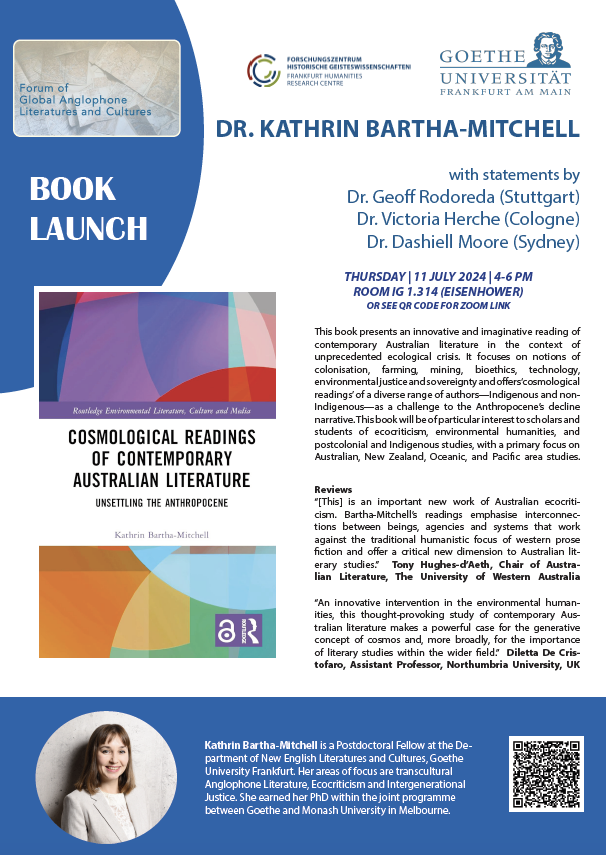
With statements by Victoria Herche (Cologne), Geoff Rodoreda (Stuttgart) and Dashiell Moore(Sydney).
This book presents an innovative and imaginative reading of contemporary Australian literature in the context of unprecedented ecological crisis. It focuses on notions of colonisation, farming, mining, bioethics, technology, environmental justice and sovereignty and offers 'cosmological readings' of a diverse range of authors—Indigenous and non-Indigenous—as a challenge to the Anthropocene's decline narrative. This book will be of particular interest to scholars and students of ecocriticism, environmental humanities, and postcolonial and Indigenous studies, with a primary focus on Australian, New Zealand, Oceanic, and Pacific area studies.
Reviews
“[This] is an important new work of Australian ecocriticism. Bartha-Mitchell's readings emphasise interconnections between beings, agencies and systems that work against the traditional humanistic focus of western prose fiction and offer a critical new dimension to Australian literary studies." Tony Hughes-d'Aeth, Chair of Australian Literature, The University of Western Australia
“An innovative intervention in the environmental humanities, this thought-provoking study of contemporary Australian literature makes a powerful case for the generative concept of cosmos and, more broadly, for the importance of literary studies within the wider field." Diletta De Cristofaro, Assistant Professor, Northumbria University, UK
Kathrin Bartha-Mitchell is a Postdoctoral Fellow at the Department of New English Literatures and Cultures, Goethe University Frankfurt. Her areas of focus are transcultural Anglophone Literature, Ecocriticism and Intergenerational Justice. She earned her PhD within the joint programme between Goethe and Monash University in Melbourne.
NELK
"40 Years of the Wasteland: The Making of Mad Max in Far West New South Wales, Australia"
Guest lecture by Melanie Ashe (Monash) | 4 July 2024, 4-6pm, IG 1.314 (Eisenhower)
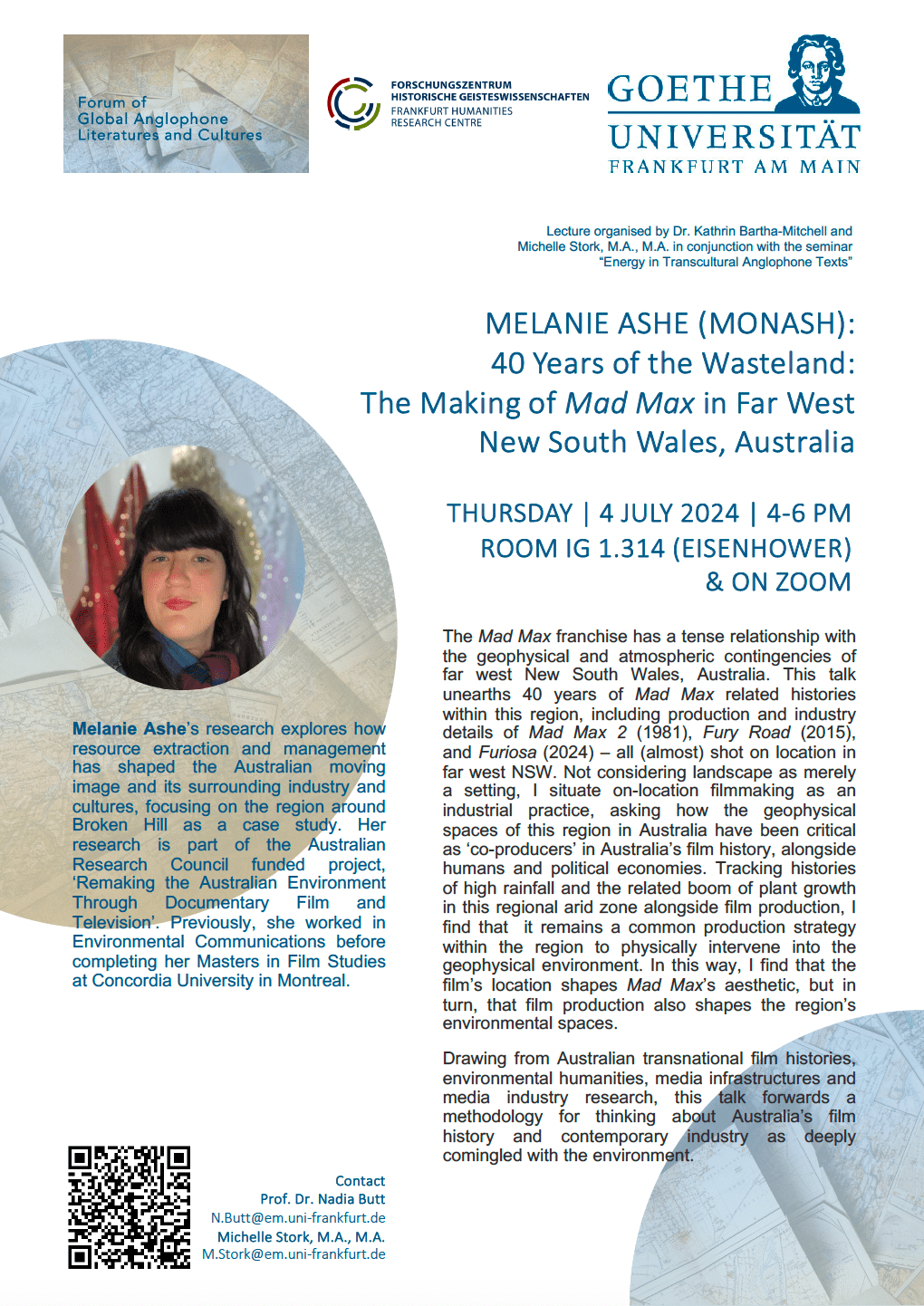
This guest lecture will also take place on Zoom. To join on us Zoom, please use the following details:
Meeting ID: 629 9728 6450
Passcode: 776261
The Mad Max franchise has a tense relationship with the geophysical and atmospheric contingencies of far west New South Wales, Australia. In 2011, Mad Max: Fury Road was set to film in the region, taking advantage of the area's known vast arid “outback" plains. However, production was suddenly halted due to recent rainfall in the region. The location had become 'too green' to conform to the apocalyptic stylings of Mad Max. The film was delayed, and eventually ended up being relocated to Namibia, Africa. While the region not being arid enough to perform its duty as a Mad Max location was widely publicised, what is lesser known is that the region has struggled with producing the apocalyptic aesthetic of the films since the 1980s.
This talk unearths 40 years of Mad Max related histories within this region, including production and industry details of Mad Max 2 (1981), Fury Road (2015), and Furiosa (2024) – all (almost) shot on location in far west NSW. Not considering landscape as merely a setting, I situate on-location filmmaking as an industrial practice, asking how the geophysical spaces of this region in Australia have been critical as 'co-producers' in Australia's film history, alongside humans and political economies. Tracking histories of high rainfall and the related boom of plant growth in this regional arid zone alongside film production, I find that it remains a common production strategy within the region to physically intervene into the geophysical environment. In this way, I find that the film's location shapes Mad Max's aesthetic, but in turn, that film production also shapes the region's environmental spaces.
Drawing from Australian transnational film histories, environmental humanities, media infrastructures and media industry research, this talk forwards a methodology for thinking about Australia's film history and contemporary industry as deeply comingled with the environment.
Melanie Ashe's research explores how resource extraction and management has shaped the Australian moving image and its surrounding industry and cultures, focusing on the region around Broken Hill as a case study. Her research is part of the Australian Research Council funded project,'Remaking the Australian Environment Through Documentary Film and Television'. Previously, she worked in Environmental Communications before completing her Masters in Film Studies at Concordia University in Montreal.