Blog
Chaincourt Theatre
From: UniReport 6.24, author: Dr. Dirk Frank
A classic with a contemporary twist: The Chaincourt Theatre
Company is performing Shakespeare’s “Hamlet”
The Chaincourt Theatre Company at Goethe University Frankfurt is
performing Shakespeare’s “Hamlet” in the 2024/25 winter semester
“Time is
out of joint!” Shakespeare’s protagonist Hamlet begins the eponymous play with
these words describing a time of political upheaval, uncertainty about the
future and untrustworthy leaders. Although Shakespeare’s Hamlet was first
performed more than 400 years ago, it couldn’t be more topical: Time is indeed
out of joint.
This year, the Chaincourt Theatre Company dares to
tackle Shakespeare’s Hamlet, one of the world’s most famous and challenging
plays. Following his father’s death, Hamlet, the crown prince of Denmark,
returns to the Danish court, only to discover that his uncle has ascended the
throne and married his mother. What’s more, his father’s ghost is haunting the
court with terrible news and a mission for Hamlet: revenge. What follows is a
story full of intrigue, questions of individual responsibility, love and
madness.
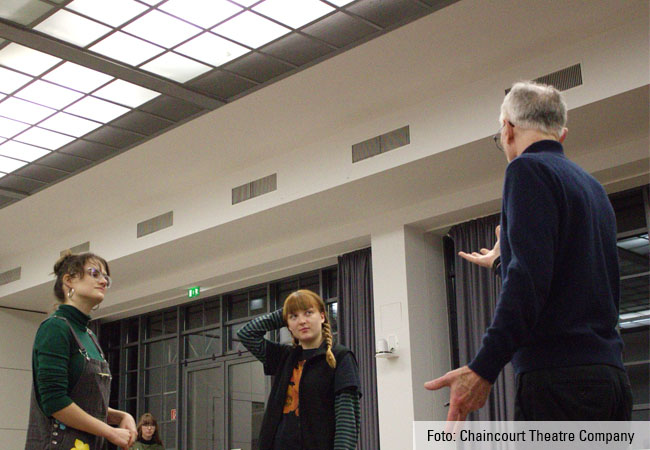
Consisting of a cast of students from various
faculties, Goethe University Frankfurt’s Chaincourt Theatre Company consists of
new and familiar faces both on and offstage. The group is led by James Fisk, a
lecturer in English and English Studies at the Institute for English and
American Studies, who is also the theater’s artistic director. “Join us in
travelling to a time out of joint and enjoy the resulting performance,
characterized by a combination of ambitious new arrivals and years of acting
and theater experience,” Fisk says. Performances are in English and take place
on the stage in the IG-Farbenhaus annex.
Performances: Premiere
on January 31; further shows on February 1, 6, 7 and 8. The performance starts
at 7:30 pm. Venue: Room NG 1.741, IG Farbenhaus annex, Campus Westend.
Tickets: 10 €/5 € (discount) – tickets are available at the box office one hour before the performance begins (no advance booking).
Contact: James Fisk
(artistic director), fisk@em.uni-frankfurt.de
or via Instagram @chaincourttheatre
TEFL
More than
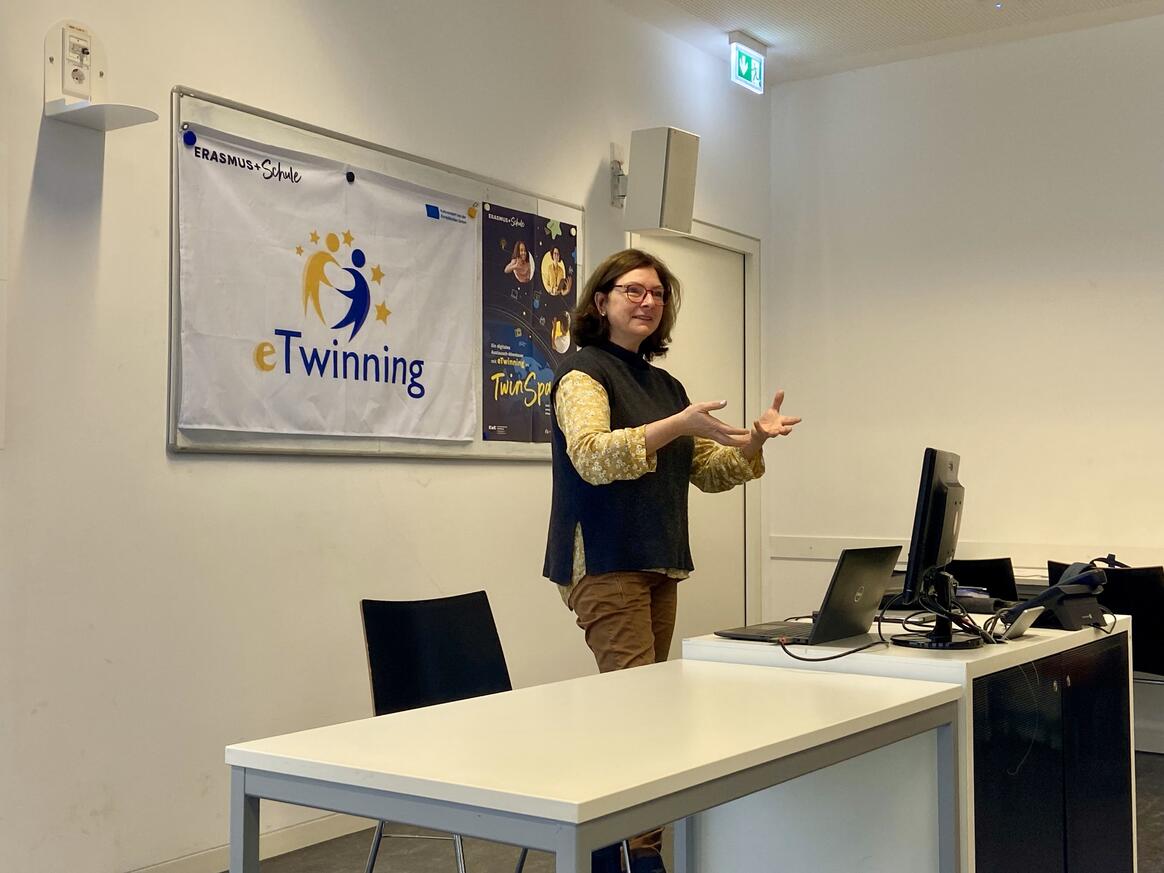
25 students followed Prof. Dr. Stefanie Frisch's (IEAS) invitation to take part in a
workshop on the eTwinning program on 4 December. The European Commission's
initiative networks teachers across Europe to facilitate joint educational
projects across national borders. The aim of Klaudia Gebhardt's workshop (Lehrkräfteakademie
Hessen & Steinhöfelschule Hildesheim/Mainz) was to present the project to
interested students and to explain its potentials as well as its difficulties
in practice.
The programme
offers a network of European schools via the internet and the possibility of
establishing partnerships (Erasmus+) and carrying out joint educational
projects. Since 2022, this has been done through the “European School Education
Platform”. Interested teachers and students can gain access via the university
or their school. The platform can be used to start projects together with
partners from other countries, find partners for one’s own projects, or discover
existing projects by other teachers across Europe.
Klaudia
Gebhardt shared many examples of best practices from her work with eTwinning.
Topics ranged from sharing winter festival traditions to conducting experiments
together in order to better understand the causes of the climate change. Although
it can be difficult to motivate all the students at first, most of them quickly
see the benefits and are enthusiastic about the project, says Klaudia Gebhardt.
„It may not help to get rid of prejudices, but it does help to reduce them,”
she says of her experience with the programme, which she underlines with many
positive examples from students. Students may even make contacts beyond the
school project. Prof. Dr. Stefanie Frisch concluded: „These examples show us
the variety of possibilities there are. In every project, intercultural
learning was promoted to some extent.“
You can
find more information on eTwinning at: https://school-education.ec.europa.eu/en/etwinning/about
NELK

Symposium and Book Launch
04
Dec 2024, Casino 1.801
18:00-20:00
& Zoom
Insurgent Cultures.
World Literatures and Violence from the Global South (Cambridge University
Press, 2024) by Pavan
Kumar Malreddy.
With Sinan
Antoon (New York), Delphine Munos (Liège), Miriam Nandi (Leipzig), Tom McCarthy (Berlin)
and Auritro
Majumder (Houston)
Chair: Frank Schulze-Engler
Participation via Zoom
is possible: https://zoomto.me/OUO5Z | Passcode:
878754
Contact: c.argast@em.uni-frankfurt.de
Organized by
ConTrust—Trust in Conflict, the Forum of Global Anglophone Literatures and
Cultures & The Department of New English Literatures and Cultures
TEFL
Room: SH 0.107
Workshop by Klaudia Gebhardt: Making foreign languages worth speaking