

BA & Teaching degree
Proof of Language Competence

Degree courses and application

- BA English Studies (HF/ NF)
- BA American Studies (HF/ NF)
- Teaching degree English
(L1/ L2/ L3/ L5)
- MA Anglophone Literature, Culture and Media
- MA American Studies
- MA Moving Cultures
Further info concerning the application process can be found here.
Guidance for first semester students


Events and Dates

Examination regulations

Teaching English (L1/ L2/ L3/ L5)
Resources & Links

Student Engagement

Job openings at IEAS

International Student Services

Incoming international students can find useful information on the Global Office's website.


Events
Call for papers: Postcolonialism(s) across Contexts: Connecting Postcolonial Studies across Continents and Legacies

Postcolonial @ Goethe
Postcolonialism(s) across Contexts: Connecting Postcolonial Studies across Continents
and Legacies
Date: 5-6 April 2027
Place: Goethe University Frankfurt
This conference provides an opportunity for students at early stages of their academic careers
to present their research, exchange ideas, and connect with peers. It further offers a platform
for engaging with Postcolonial Studies and for critically examining experiences of
colonisation across different historical and cultural legacies. By bringing these diverse
perspectives into dialogue, the conference seeks to foster reflection on shared experiences
while acknowledging the complexities and particularities of individual colonial histories.
We welcome contributions engaging with Postcolonial Studies in connection to related
fields, including but not limited to:
- Postcolonial and Decolonial Studies
- Colonialism and Imperialism
- Literary and Media Studies
- Social Studies
- Cultural Studies
- History and Memory Studies
- Race, Ethnicity, and Identity
- Migration, Diaspora, and Transnational Studies
- Gender and Queer Studies
- Indigenous Studies
- Language, Translation, and Linguistics
- Representation and Visual Culture
- Comparative Approaches to Colonial and Postcolonial Experiences
Participants will be asked to convey a presentation of 10-15 minutes related but not limited to the above mentioned areas of research.
Abstracts of 200 words and a short researcher's bio should be submitted to this email (postcolonialatgoethe@gmail.com) by December 27, 2026. Applicants will be notified of the decision by 31 January 2027.
Format: Times New Roman, size 12, 1,5 spacing, MLA format citation style. Please note that
AI-generated abstracts will not be accepted. All submitted abstracts must be written by the
applicants themselves and reflect their own original ideas and research.
Please note that the conference is open to students from other universities. However, travel and accommodation expenses cannot be covered by the organisers.


American Studies
Room: IG 254 & online
Guest Lecture in cooperation with the Cornelia Goethe Center and the ‘Frankfurt School of Hope’: Colby Gordon (Bryn Mawr College): “Towards a Postsecular Trans Studies” | American Studies Research Colloquium WiSe 26/27

NELK
Lucy Bond (Westminster) and Jessica Rapson (King’s College): Towards a Political Economy of Memory: Racial Capitalism and Heritage Tourism in the US Gulf South
Guest lecture: Towards a Political Economy of Memory: Racial Capitalism and Heritage Tourism in the US Gulf South

American Studies
Room: IG 254 & online
Guest Lecture in cooperation with the Cornelia Goethe Center and the ‘Frankfurt School of Hope’: Colby Gordon (Bryn Mawr College): “Towards a Postsecular Trans Studies” | American Studies Research Colloquium WiSe 26/27
American Studies
Room: Cas 1.812 & online
CANCELLED: "Storylistening" Workshop with Sarah Dillon (University of Cambridge)


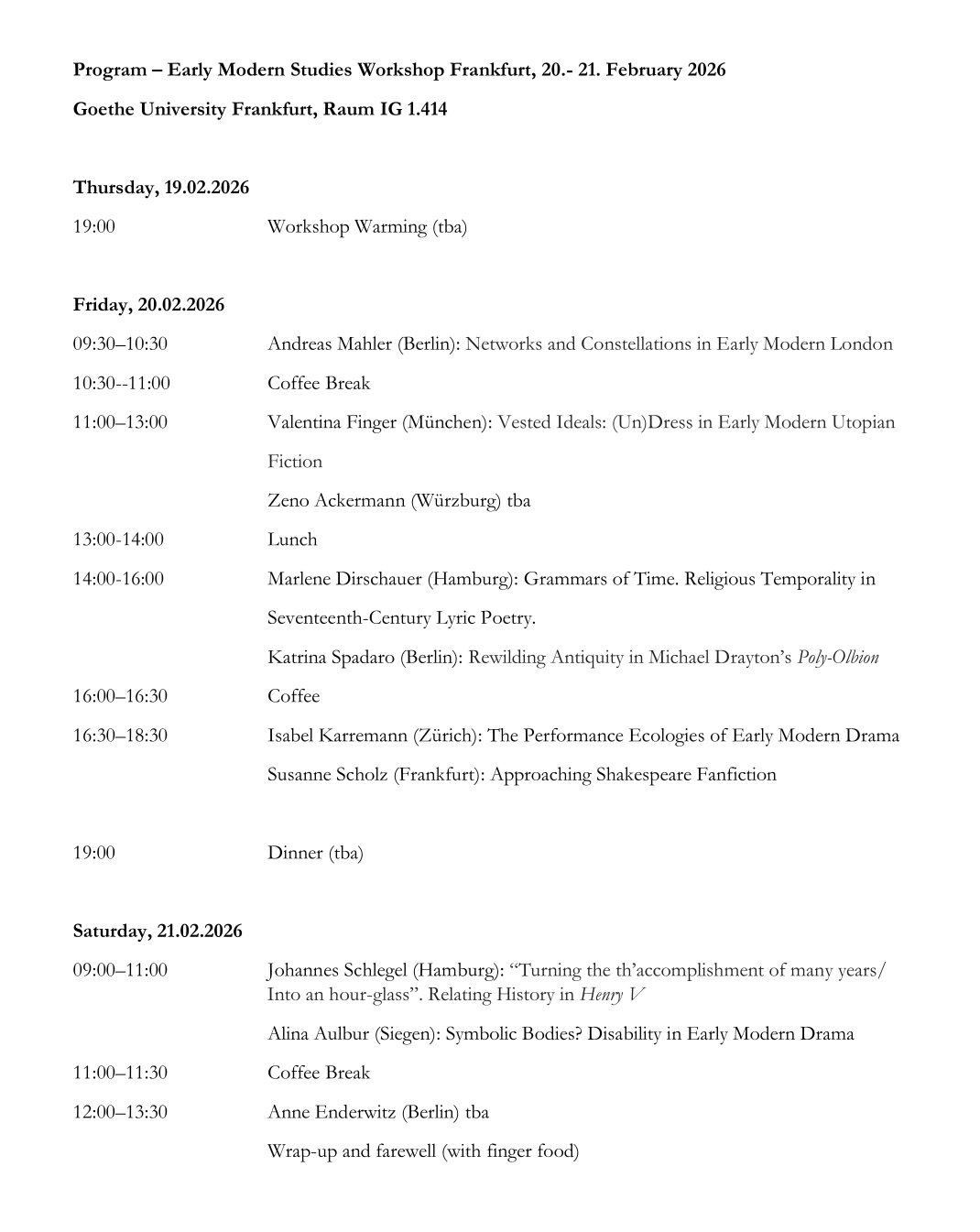
English Studies
IG 1.414
4th Early Modern Studies Workshop
English Studies
31 October – 1 November 2025 | Goethe University Frankfurt
Workshop: The Companies We Keep – Figurations, Narratives, and Practices of Co-Living in Common Spaces

For further information and the full programme please contact bayerlipp@em.uni-fankfurt.de
NELK
Lucy Bond (Westminster) and Jessica Rapson (King’s College): Towards a Political Economy of Memory: Racial Capitalism and Heritage Tourism in the US Gulf South
Guest lecture: Towards a Political Economy of Memory: Racial Capitalism and Heritage Tourism in the US Gulf South

NELK
A special issue to appear in Memory Studies Review
Call for Papers: (Post)Coloniality and Memory
NELK
Eva von Contzen (Freiburg): Telling Again, Anew, Against: Repetition and Literary History

What does it mean to retell a story? In recent Anglophone literature, retellings have become extremely popular, from Pat Barker's The Silence of the Girls to Percival Everett's James. Retellings use existing, often much older, narrative material, and tell the story anew by adapting it to the needs and expectations of a contemporary readership. Placing the current trend of retellings in its wider context of literary history, I argue that repetition is the key generator of meaning in the retelling process.
Eva von Contzen is professor of English Literature including the literature of the Middle Ages at the University of Freiburg. She is PI of the ERC-funded project “Retelling and Repetition (DERIVATE)". Her research interests include narrative theory, literary history, reception studies, retellings, and lists.
Linguistics
New colleague: Jana-Elina Jordan

About
My academic journey
started with a bachelor's degree in English
Studies and Romance Studies at Goethe-University Frankfurt, where I
specialized in English and French linguistics. To expand and deepen my
knowledge in theoretical linguistics, I continued my studies at
Goethe-University Frankfurt with a master's degree in Linguistics.
Having previously worked as a student assistant and tutor in the
linguistics department of the IEAS, I am excited to return as a PhD
student.
Interests
I am interested in
different phenomena at the
syntax-semantics-pragmatics interface, especially from an empirical
and contrastive perspective. For example, in my master's thesis, I
investigated the interaction between information structure and word order
variation in the German middle field using corpus and
experimental methods. As a member of Project B01
within the SFB
„NegLab,“ I will be carrying out corpus and experimental studies on
negation and quantification in German.
Linguistics
Melnik & Sailer edit special issue on “Constructional approaches in formal grammar”
TEFL
WiPS Workshop 28.10.2026
Connecting Classroom Practice and Research: Teacher Training for English Language Teachers

The workshop explored the challenges of writing in English as a foreign language and ways to motivate and support young writers. Participants were introduced to engaging writing tasks for the upcoming Christmas season and different approaches to providing feedback on young learners’ written work were discussed.
The workshop also provided an opportunity to discuss school-university research partnerships. Later this school year, classroom investigations involving individual participants will explore questions concerning the particular challenges of providing teacher feedback on young learners’ writing.
Participants responded positively to the workshop and emphasised the importance of professional development opportunities specifically tailored to primary school English teachers.
TEFL
Raum: Cas 1.811
Workshop: Schreiben im Englischunterricht der Grundschule: motivieren, unterstützen, Feedback geben


Sprachpraxis
New colleague: Olivia Smith
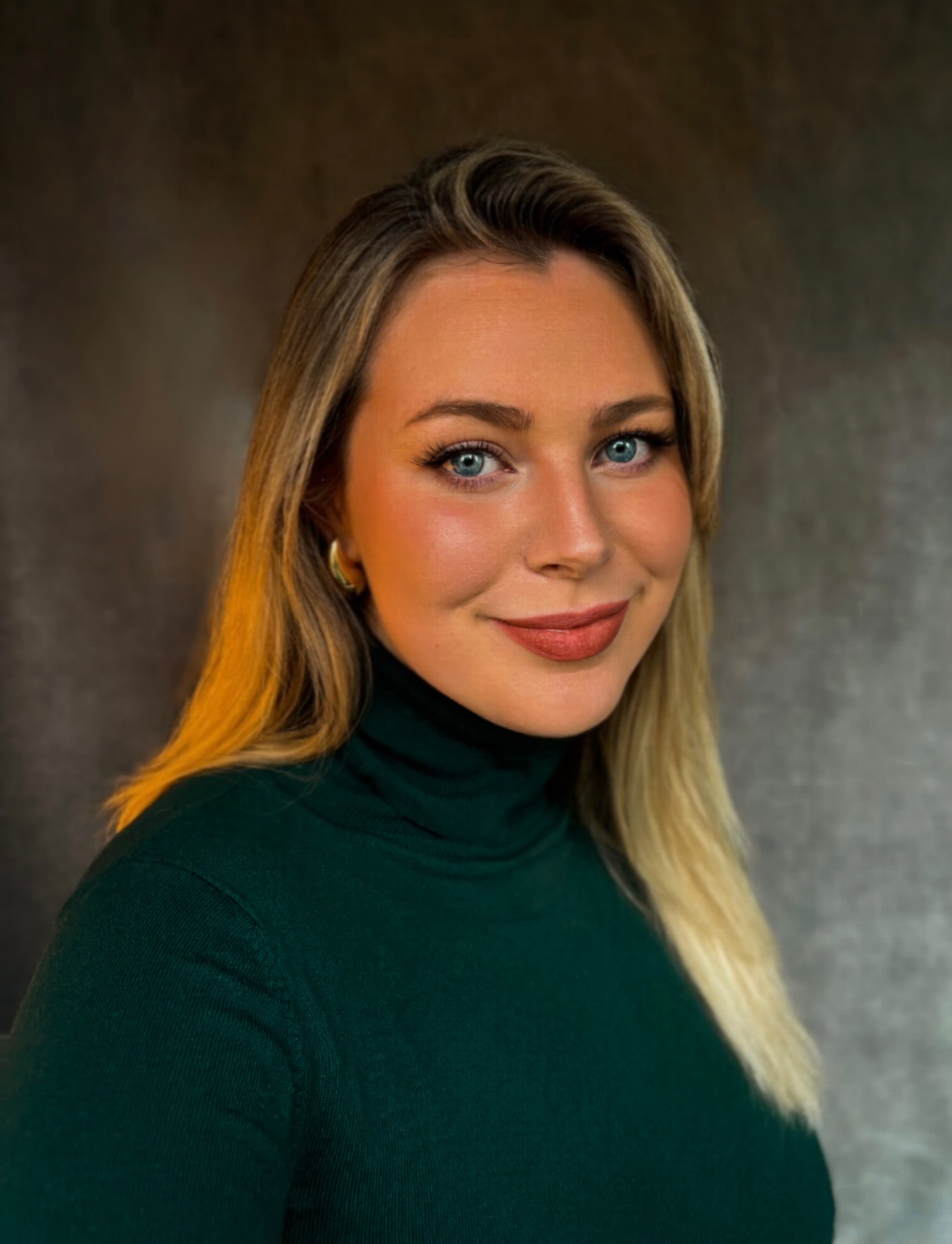
The Sprachpraxis is delighted to welcome a new lector to its team!
Olivia is a writer from Ireland with a degree in English Studies from Trinity College Dublin and a master's degree in Anglophone Literatures, Cultures and Media from Goethe University. This semester she'll draw on her unique background to teach our first semester composition classes, Writing II: Irish Short Stories, ILS II: Book Club and our master's writing colloquium. Her research interests include Irish literature, Gothic fiction, gender studies and memory studies.
Chaincourt Theatre
Chaincourt Theatre - Summer Semester 2026 production
"Missing Persons"

“In life, it's not the future that counts. It's the past."
The Chaincourt Theatre Company brings to the stage an adaptation of Patrick Modiano's novel Rue des Boutiques Obscures (Prix Goncourt 1978) under the name Missing Persons
What makes up a life, materially and immaterially? To what, if to any of this, do we have access when it's all said and done? In this play, Guy Roland, a private detective in Paris, tries to solve the mystery of his own past. His memories erased by amnesia, he has no idea where he is from, or even his real name. His search leads him to shadowy figures, also at odds with their past, who pass onto him mementoes, photographs, documents, and stories which provide him with missing pieces of his fractured identity. Over the course of the play, Guy Roland's task is to make sense of it all.
Born in Boulogne-Billancourt, France in 1945, Patrick Modiano's more than forty works deal with individual and collective identities as well as with memory and loss. Patrick Modiano was the recipient of the Nobel Prize for Literature in 2014
The Chaincourt Theatre Company is made up of students from various faculties, alumni, and staff from Goethe University. The company has produced under this name since the mid-1990's. Prior to this time, it was known as IEAS Theatre. Irrespective of name, the company has brought English language theatre to Frankfurt audiences since 1955.
Performances: Opening night is on July 3rd; additional performances are on July 4th, 9th, 10th, and 11th (closing night). Curtain is at 7:30 p.m.
Tickets: 10€ (general admission) and 5€ (reduced); tickets are only available at the box office one hour before curtain (6:30 p.m.); no advance ticket sales.
Location: Goethe University, Campus Westend, IG Farbenhaus-Nebengebäude, room NG 1.741
Contact: James Fisk (Artistic Director); fisk@em.uni-frankfurt.de
Chaincourt Theatre
Chaincourt Theater - Winter semester 2025/26 production
"Glengarry Glen Ross" by David Mamet
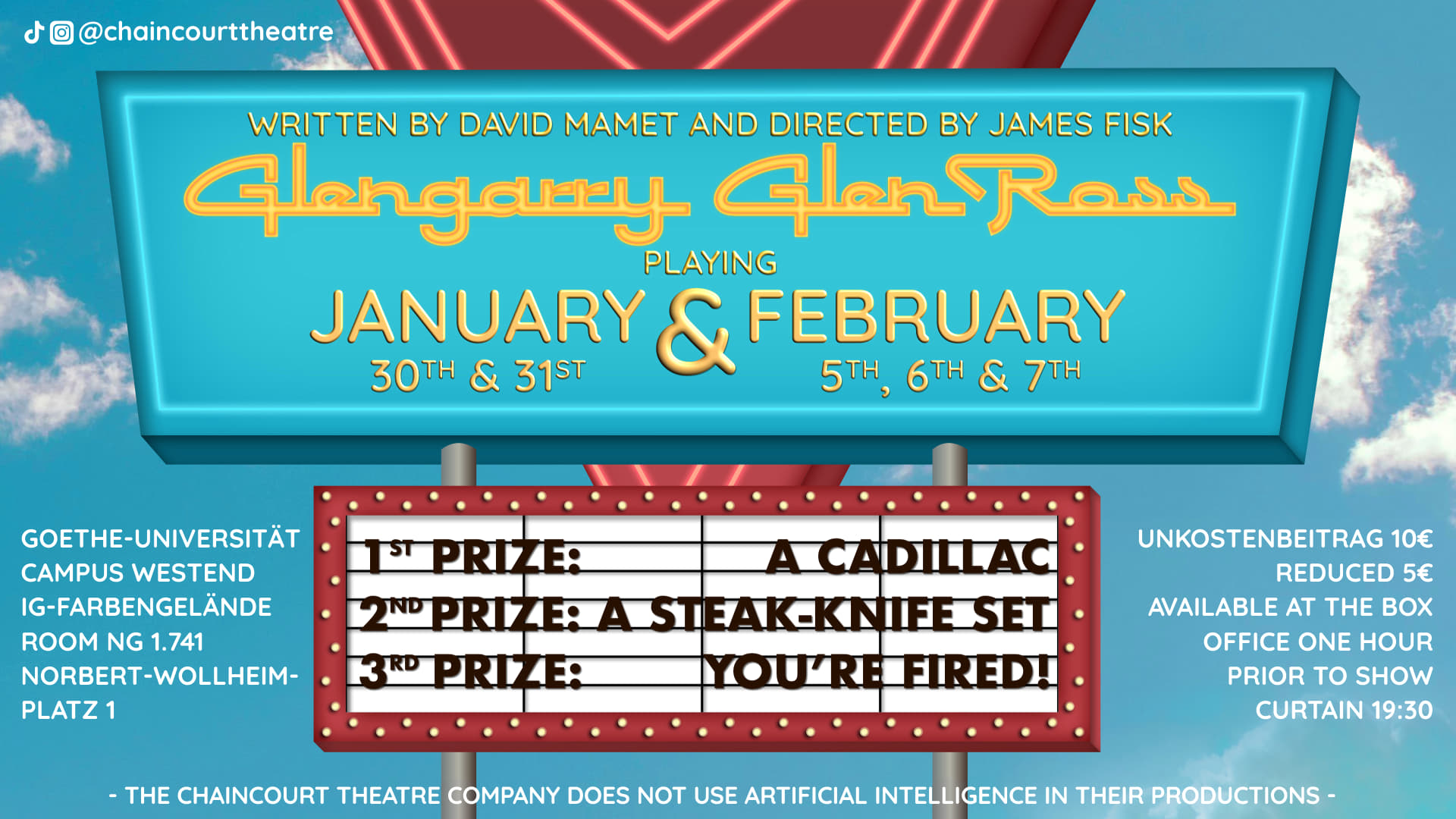
Wealth, Power, Success, and Survival
The Chaincourt Theatre Company brings to the stage David Mamet’s Glengarry
Glen Ross
How
far should one go to attain wealth and success?
Which values can be compromised in this pursuit? What measures can one take in a cut-throat
competitive, materially obsessed world?
Are these goals only to be obtained through a ruthlessly single-minded
attitude? These are some of the
questions playwright David Mamet confronts us with in Glengarry Glen Ross.
In
his play, four real-estate agents find themselves thrown into a fight for
survival over the course of one week by the owners of the agency in an attempt
to increase profits. The agent with the
most sales wins a Cadillac El Dorado; the one with the second most sales wins a
set of steak knives. The last two are
fired. The agents respond with a mix of
ambition, desperation, and morally questionable actions to keep their
jobs. In this way, David Mamet presents
us with an all-too-familiar contemporary working world and challenges us to
examine its existential value.
Born
in Chicago in 1947, David Mamet is a playwright, author, screenwriter, and
director. His play, Glengarry Glen
Ross won the Pulitzer Prize in 1984.
Mamet’s dialogue has been referred to as “Mametspeak”, a style of
script-writing which influences television and screenwriters to this day.
The Chaincourt Theatre Company is made up of students from various
faculties, alumni, and staff. It has
produced under this name since the mid-1990’s.
Before that, it went by IEAS Theatre.
Performances: Opening night on
January 30th 2026; additional performances on January 31st
as well as on February 5th, 6th, and 7th
(closing night). Curtain is at 7:30 p.m.
Tickets: 10€ (general admission) and 5€
(reduced); tickets are only available at the box office one hour before curtain
(6:30 p.m.); no advance ticket sales.
Location:
Goethe University, Campus Westend, IG Farbenhaus-Nebengebäude, room NG 1.741
Contact: James Fisk (Artistic Director);
fisk@em.uni-frankfurt.de
Chaincourt Theatre
Chaincourt Theater - Summer semester 2025 production
"An Ideal Husband"
Literary Journal
Call for Student Editors: The IEAS Literary Journal

Literary Journal
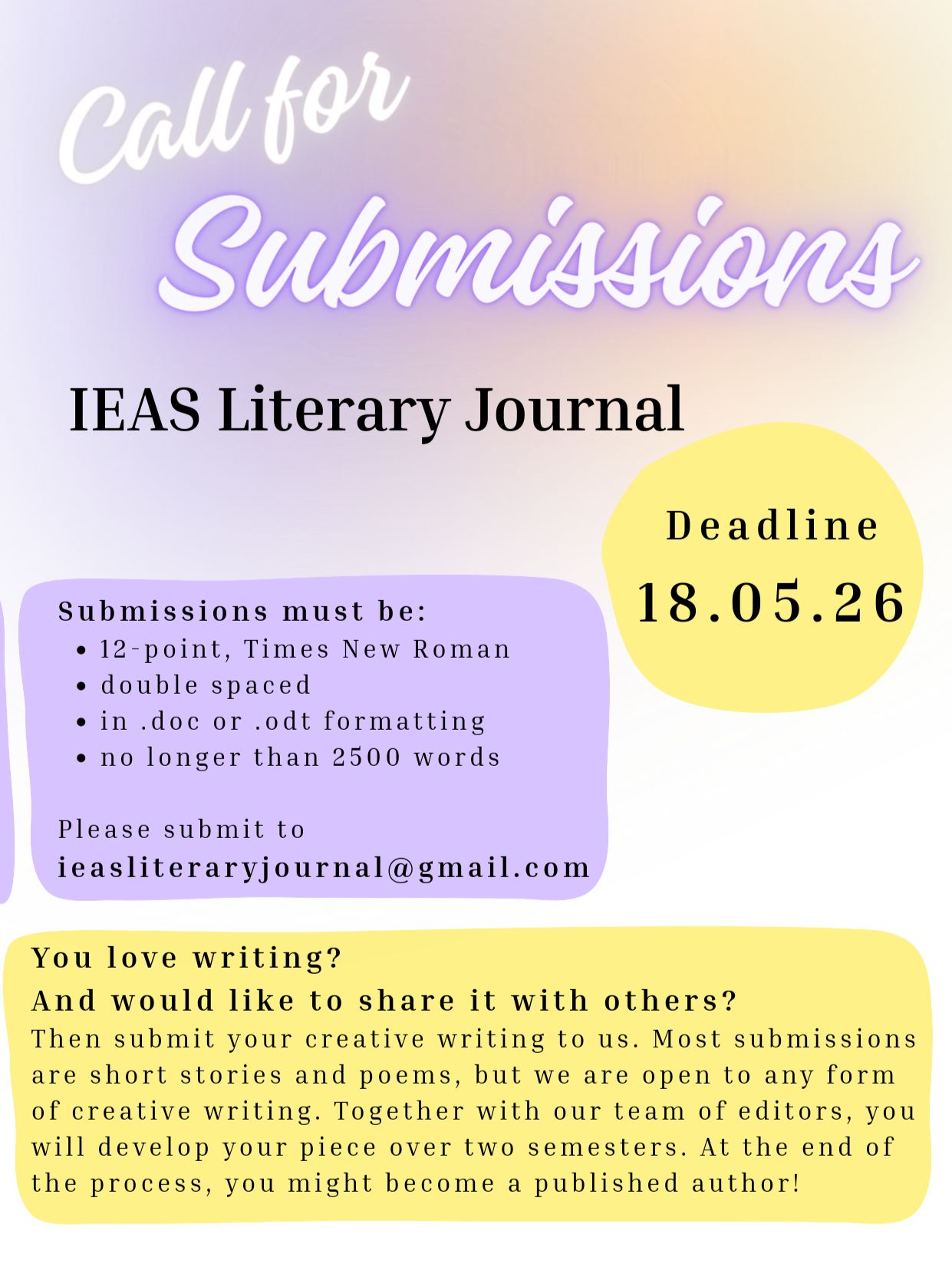
Call for Submissions: Literary Journal, Volume 9
American Studies
Room: IG 254 & online
Guest Lecture in cooperation with the Cornelia Goethe Center and the ‘Frankfurt School of Hope’: Colby Gordon (Bryn Mawr College): “Towards a Postsecular Trans Studies” | American Studies Research Colloquium WiSe 26/27
American Studies
Room: Cas 1.812 & online
CANCELLED: "Storylistening" Workshop with Sarah Dillon (University of Cambridge)
English Studies
IG 1.414
4th Early Modern Studies Workshop
English Studies
31 October – 1 November 2025 | Goethe University Frankfurt
Workshop: The Companies We Keep – Figurations, Narratives, and Practices of Co-Living in Common Spaces
For further information and the full programme please contact bayerlipp@em.uni-fankfurt.de
NELK
Lucy Bond (Westminster) and Jessica Rapson (King’s College): Towards a Political Economy of Memory: Racial Capitalism and Heritage Tourism in the US Gulf South
Guest lecture: Towards a Political Economy of Memory: Racial Capitalism and Heritage Tourism in the US Gulf South
NELK
A special issue to appear in Memory Studies Review
Call for Papers: (Post)Coloniality and Memory
NELK
Eva von Contzen (Freiburg): Telling Again, Anew, Against: Repetition and Literary History
What does it mean to retell a story? In recent Anglophone literature, retellings have become extremely popular, from Pat Barker's The Silence of the Girls to Percival Everett's James. Retellings use existing, often much older, narrative material, and tell the story anew by adapting it to the needs and expectations of a contemporary readership. Placing the current trend of retellings in its wider context of literary history, I argue that repetition is the key generator of meaning in the retelling process.
Eva von Contzen is professor of English Literature including the literature of the Middle Ages at the University of Freiburg. She is PI of the ERC-funded project “Retelling and Repetition (DERIVATE)". Her research interests include narrative theory, literary history, reception studies, retellings, and lists.
Linguistics
New colleague: Jana-Elina Jordan
About
My academic journey
started with a bachelor's degree in English
Studies and Romance Studies at Goethe-University Frankfurt, where I
specialized in English and French linguistics. To expand and deepen my
knowledge in theoretical linguistics, I continued my studies at
Goethe-University Frankfurt with a master's degree in Linguistics.
Having previously worked as a student assistant and tutor in the
linguistics department of the IEAS, I am excited to return as a PhD
student.
Interests
I am interested in
different phenomena at the
syntax-semantics-pragmatics interface, especially from an empirical
and contrastive perspective. For example, in my master's thesis, I
investigated the interaction between information structure and word order
variation in the German middle field using corpus and
experimental methods. As a member of Project B01
within the SFB
„NegLab,“ I will be carrying out corpus and experimental studies on
negation and quantification in German.
Linguistics
Melnik & Sailer edit special issue on “Constructional approaches in formal grammar”
TEFL
WiPS Workshop 28.10.2026
Connecting Classroom Practice and Research: Teacher Training for English Language Teachers
The workshop explored the challenges of writing in English as a foreign language and ways to motivate and support young writers. Participants were introduced to engaging writing tasks for the upcoming Christmas season and different approaches to providing feedback on young learners’ written work were discussed.
The workshop also provided an opportunity to discuss school-university research partnerships. Later this school year, classroom investigations involving individual participants will explore questions concerning the particular challenges of providing teacher feedback on young learners’ writing.
Participants responded positively to the workshop and emphasised the importance of professional development opportunities specifically tailored to primary school English teachers.
TEFL
Raum: Cas 1.811
Workshop: Schreiben im Englischunterricht der Grundschule: motivieren, unterstützen, Feedback geben
Sprachpraxis
New colleague: Olivia Smith
The Sprachpraxis is delighted to welcome a new lector to its team!
Olivia is a writer from Ireland with a degree in English Studies from Trinity College Dublin and a master's degree in Anglophone Literatures, Cultures and Media from Goethe University. This semester she'll draw on her unique background to teach our first semester composition classes, Writing II: Irish Short Stories, ILS II: Book Club and our master's writing colloquium. Her research interests include Irish literature, Gothic fiction, gender studies and memory studies.
Chaincourt Theatre
Chaincourt Theatre - Summer Semester 2026 production
"Missing Persons"
“In life, it's not the future that counts. It's the past."
The Chaincourt Theatre Company brings to the stage an adaptation of Patrick Modiano's novel Rue des Boutiques Obscures (Prix Goncourt 1978) under the name Missing Persons
What makes up a life, materially and immaterially? To what, if to any of this, do we have access when it's all said and done? In this play, Guy Roland, a private detective in Paris, tries to solve the mystery of his own past. His memories erased by amnesia, he has no idea where he is from, or even his real name. His search leads him to shadowy figures, also at odds with their past, who pass onto him mementoes, photographs, documents, and stories which provide him with missing pieces of his fractured identity. Over the course of the play, Guy Roland's task is to make sense of it all.
Born in Boulogne-Billancourt, France in 1945, Patrick Modiano's more than forty works deal with individual and collective identities as well as with memory and loss. Patrick Modiano was the recipient of the Nobel Prize for Literature in 2014
The Chaincourt Theatre Company is made up of students from various faculties, alumni, and staff from Goethe University. The company has produced under this name since the mid-1990's. Prior to this time, it was known as IEAS Theatre. Irrespective of name, the company has brought English language theatre to Frankfurt audiences since 1955.
Performances: Opening night is on July 3rd; additional performances are on July 4th, 9th, 10th, and 11th (closing night). Curtain is at 7:30 p.m.
Tickets: 10€ (general admission) and 5€ (reduced); tickets are only available at the box office one hour before curtain (6:30 p.m.); no advance ticket sales.
Location: Goethe University, Campus Westend, IG Farbenhaus-Nebengebäude, room NG 1.741
Contact: James Fisk (Artistic Director); fisk@em.uni-frankfurt.de
Chaincourt Theatre
Chaincourt Theater - Winter semester 2025/26 production
"Glengarry Glen Ross" by David Mamet
Wealth, Power, Success, and Survival
The Chaincourt Theatre Company brings to the stage David Mamet’s Glengarry
Glen Ross
How
far should one go to attain wealth and success?
Which values can be compromised in this pursuit? What measures can one take in a cut-throat
competitive, materially obsessed world?
Are these goals only to be obtained through a ruthlessly single-minded
attitude? These are some of the
questions playwright David Mamet confronts us with in Glengarry Glen Ross.
In
his play, four real-estate agents find themselves thrown into a fight for
survival over the course of one week by the owners of the agency in an attempt
to increase profits. The agent with the
most sales wins a Cadillac El Dorado; the one with the second most sales wins a
set of steak knives. The last two are
fired. The agents respond with a mix of
ambition, desperation, and morally questionable actions to keep their
jobs. In this way, David Mamet presents
us with an all-too-familiar contemporary working world and challenges us to
examine its existential value.
Born
in Chicago in 1947, David Mamet is a playwright, author, screenwriter, and
director. His play, Glengarry Glen
Ross won the Pulitzer Prize in 1984.
Mamet’s dialogue has been referred to as “Mametspeak”, a style of
script-writing which influences television and screenwriters to this day.
The Chaincourt Theatre Company is made up of students from various
faculties, alumni, and staff. It has
produced under this name since the mid-1990’s.
Before that, it went by IEAS Theatre.
Performances: Opening night on
January 30th 2026; additional performances on January 31st
as well as on February 5th, 6th, and 7th
(closing night). Curtain is at 7:30 p.m.
Tickets: 10€ (general admission) and 5€
(reduced); tickets are only available at the box office one hour before curtain
(6:30 p.m.); no advance ticket sales.
Location:
Goethe University, Campus Westend, IG Farbenhaus-Nebengebäude, room NG 1.741
Contact: James Fisk (Artistic Director);
fisk@em.uni-frankfurt.de
Chaincourt Theatre
Chaincourt Theater - Summer semester 2025 production
"An Ideal Husband"
Literary Journal
Call for Student Editors: The IEAS Literary Journal
Literary Journal
Call for Submissions: Literary Journal, Volume 9

Department Office
American Studies

Department Office
American Studies

Department Office
English Studies

Department Office
NELK

Department Office
TEFL and Linguistics

Academic Programme Advisor
BA American Studies
Academic Programme Advisor
BA English Studies

Academic Programme Advisor
Teaching English
Academic Programme Advisor
MA American Studies
Academic Programme Advisor
MA ALCM
Academic Programme Advisor
MA MCTE
Consultation
North America Exchange Programme
Consultation
Erasmus Exchange Programme
Consultation
Assistant Teacher Programme

Consultation
Teaching English Internships

Consultation
BAföG
Equality Mandate at the IEAS