Blog
Chaincourt Theatre

“In life, it's not the future that counts. It's the past."
The Chaincourt Theatre Company brings to the stage an adaptation of Patrick Modiano's novel Rue des Boutiques Obscures (Prix Goncourt 1978) under the name Missing Persons
What makes up a life, materially and immaterially? To what, if to any of this, do we have access when it's all said and done? In this play, Guy Roland, a private detective in Paris, tries to solve the mystery of his own past. His memories erased by amnesia, he has no idea where he is from, or even his real name. His search leads him to shadowy figures, also at odds with their past, who pass onto him mementoes, photographs, documents, and stories which provide him with missing pieces of his fractured identity. Over the course of the play, Guy Roland's task is to make sense of it all.
Born in Boulogne-Billancourt, France in 1945, Patrick Modiano's more than forty works deal with individual and collective identities as well as with memory and loss. Patrick Modiano was the recipient of the Nobel Prize for Literature in 2014
The Chaincourt Theatre Company is made up of students from various faculties, alumni, and staff from Goethe University. The company has produced under this name since the mid-1990's. Prior to this time, it was known as IEAS Theatre. Irrespective of name, the company has brought English language theatre to Frankfurt audiences since 1955.
Performances: Opening night is on July 3rd; additional performances are on July 4th, 9th, 10th, and 11th (closing night). Curtain is at 7:30 p.m.
Tickets: 10€ (general admission) and 5€ (reduced); tickets are only available at the box office one hour before curtain (6:30 p.m.); no advance ticket sales.
Location: Goethe University, Campus Westend, IG Farbenhaus-Nebengebäude, room NG 1.741
Contact: James Fisk (Artistic Director); fisk@em.uni-frankfurt.de
American Studies
Vansh Sharma Wins DAAD Prize 2026

Vansh Sharma, student in the B.A. program in American Studies at the Department of English and American Studies, is this year's recipient of the DAAD Prize at Goethe University Frankfurt. The DAAD Prize is awarded for outstanding achievements of international students studying at German universities and is endowed with 1,000 EUR. It honors international students whose outstanding academic accomplishments are complemented by special social and intercultural engagement.
The American Studies division nominated Mr. Sharma for the exceptional quality of his academic work in American Studies and for his exemplary participation in the division's teaching and research activities. In his nomination, Prof. Dr. Johannes Völz notes that Vansh is “one of the most promising young international scholars" he has encountered in his teaching career. As a student assistant, Vansh supports Prof. Völz's professorship; as a tutor in “Introduction to Literary Studies," he helps new students develop core skills in reading and writing about literature.
Mr. Sharma is completing his B.A. in American Studies with outstanding results and will continue his academic path in the M.A. American Studies program at Goethe University from the coming winter term. Alongside his studies, he plays a leading role as co editor in chief of the IEAS Literary Journal and has been an important member of the Chaincourt Theatre Company, contributing both on stage and in production support. Within the institute's student group, he represents student interests and helps to shape the intellectual and social life of the American Studies community.
Originally from New Delhi, India, Mr. Sharma prepared for his studies at Goethe University by attending the Studienkolleg Frankfurt and has since been an active participant in university and regional initiatives. He volunteers in Goethe University's Buddy Program for international students, supports alumni networks at the Studienkolleg, and takes part in STUBE Hessen seminars and workshops on topics such as political participation, development policy, mental health, religion, and culture. As a volunteer educator with techeroes gGmbH, he teaches programming and robotics to children and adolescents, encouraging young people to discover and trust their abilities in the digital realm.
NELK

What does it mean to retell a story? In recent Anglophone literature, retellings have become extremely popular, from Pat Barker's The Silence of the Girls to Percival Everett's James. Retellings use existing, often much older, narrative material, and tell the story anew by adapting it to the needs and expectations of a contemporary readership. Placing the current trend of retellings in its wider context of literary history, I argue that repetition is the key generator of meaning in the retelling process.
Eva von Contzen is professor of English Literature including the literature of the Middle Ages at the University of Freiburg. She is PI of the ERC-funded project “Retelling and Repetition (DERIVATE)". Her research interests include narrative theory, literary history, reception studies, retellings, and lists.
NELK
Postcolonial/postsocialist memories as constellations. Reading ‘returning transitions’ in Anglophone and Russophone literatures
Ksenia Robbe (Groningen University): New Frontiers in Memory Studies: Ksenia Robbe on postcolonial/postsocialist memories as constellations
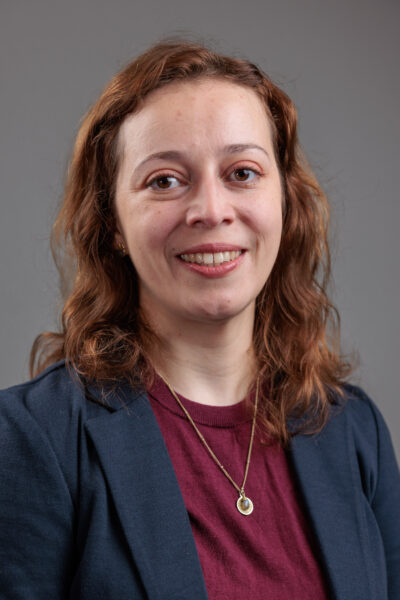
Ksenia Robbe is a Senior Lecturer in European Culture and Literature at the University of Groningen and currently a Humboldt Fellow at Goethe-University Frankfurt. Her research sits at the intersection of postcolonial and postsocialist studies, with the focus on concepts and practices of memory, time, gender, and feminism in literature and film.