Aktuelles
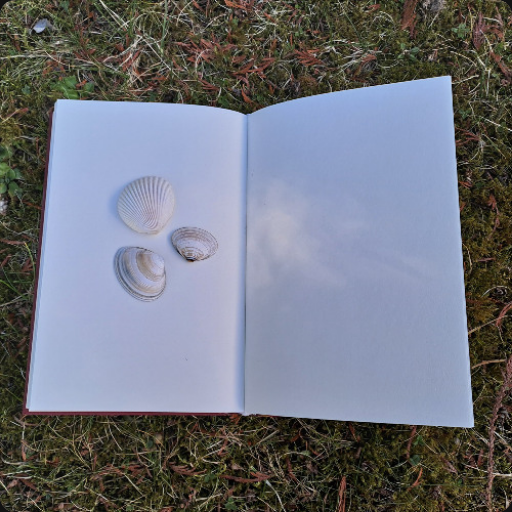
"Grønlit" ist ein Podcast von Studierenden der Goethe-Universität. Er taucht in die literarische Schatzkiste Skandinaviens ein - die des Meeres (Staffel 1) und der Biodiversität (Staffel 2 und 3).
Die neueste Folge der Staffel 3 befasst sich mit Inger Christensens "Sommerfugledalen“ (Schmetterlingstal) und kann hier angehört werden:
https://soundcloud.com/litohratur_podcast
Die erste Folge von Staffel 3, die im Wintersemester 2024/25 entstanden ist widmet sich dem Langgedicht “Östersjöar/Ostseen" von Tomas Tranströmer aus dem Jahr 1974 und der Frage, was dieses Gedicht mit dem Thema Biodiversität zu tun hat.
Die Folge kann hier angehört werden:
https://on.soundcloud.com/Iapjr2Q1ZHZqciCFI9
Podcasts als Form der Wissens- und Wissenschaftskommunikation spielen in Gegenwart und Zukunft eine wichtige Rolle. Um das Format kennenzulernen und sich in der Produktion eines Podcasts zu erproben, wurde im Sommersemester 2023 begleitend zum Seminar “Das Meer in der skandinavischen Kinder- und Jugendliteratur" sowie im Sommersemester 2024 zum Seminar "Biodiversität in der skandinavischen Kinder- und Jugendliteratur" und im Wintersemester 2024/25 zum Seminar "Biodiversität in der skandinavischen Literatur", jeweils von Prof. Dr. Frederike Felcht, ein Podcast-Workshop angeboten. An mehreren Terminen erarbeiteten die Teilnehmer:innen aus den Fächern Skandinavistik und Kinder- und Jugendliteratur unter Anleitung der Podcast- und Radioproduzentin Dr. Christina Gehrlein die Grundlagen der Audioproduktion wie Aufnahmetechnik, Mikrofonierung, Audioschnitt und Interview von der ersten Idee bis zum fertigen Podcast.
"Grønlit" ist ein Podcast von Studierenden der Goethe-Universität. Er taucht in die literarische Schatzkiste Skandinaviens ein - die des Meeres (Staffel 1) und der Biodiversität (Staffel 2 und 3).
Die neueste Folge der Staffel 3 befasst sich mit Inger Christensens "Sommerfugledalen“ (Schmetterlingstal) und kann hier angehört werden:
https://soundcloud.com/litohratur_podcast
Die erste Folge von Staffel 3, die im Wintersemester 2024/25 entstanden ist widmet sich dem Langgedicht “Östersjöar/Ostseen" von Tomas Tranströmer aus dem Jahr 1974 und der Frage, was dieses Gedicht mit dem Thema Biodiversität zu tun hat.
Die Folge kann hier angehört werden:
https://on.soundcloud.com/Iapjr2Q1ZHZqciCFI9
Podcasts als Form der Wissens- und Wissenschaftskommunikation spielen in Gegenwart und Zukunft eine wichtige Rolle. Um das Format kennenzulernen und sich in der Produktion eines Podcasts zu erproben, wurde im Sommersemester 2023 begleitend zum Seminar “Das Meer in der skandinavischen Kinder- und Jugendliteratur" sowie im Sommersemester 2024 zum Seminar "Biodiversität in der skandinavischen Kinder- und Jugendliteratur" und im Wintersemester 2024/25 zum Seminar "Biodiversität in der skandinavischen Literatur", jeweils von Prof. Dr. Frederike Felcht, ein Podcast-Workshop angeboten. An mehreren Terminen erarbeiteten die Teilnehmer:innen aus den Fächern Skandinavistik und Kinder- und Jugendliteratur unter Anleitung der Podcast- und Radioproduzentin Dr. Christina Gehrlein die Grundlagen der Audioproduktion wie Aufnahmetechnik, Mikrofonierung, Audioschnitt und Interview von der ersten Idee bis zum fertigen Podcast.
Neuerscheinungen/ Publikationen

Frederike Felcht, Søren Frank and Katie Ritson: The Sea in Nordic Literature. Oceanic
Criticism and Blue Humanties, London: Routledge 2026.
The first collection to address the role of the oceanic in literary texts and traditions from across the Nordic region, this book explores applications of ecocriticism, postcolonial theory, new materialism, and gender studies at a time when interest in marine ecosystems and their vulnerabilities to anthropogenic climate change is generating new theoretical insights and interest across the humanities.
The Nordic countries with their long coastlines and archipelagic geographies have long histories of seafaring and mariculture. This book simultaneously introduces Nordic literatures about the sea to international scholars with an interest in the oceanic and blue humanities to scholars working within Scandinavian/Nordic Studies.
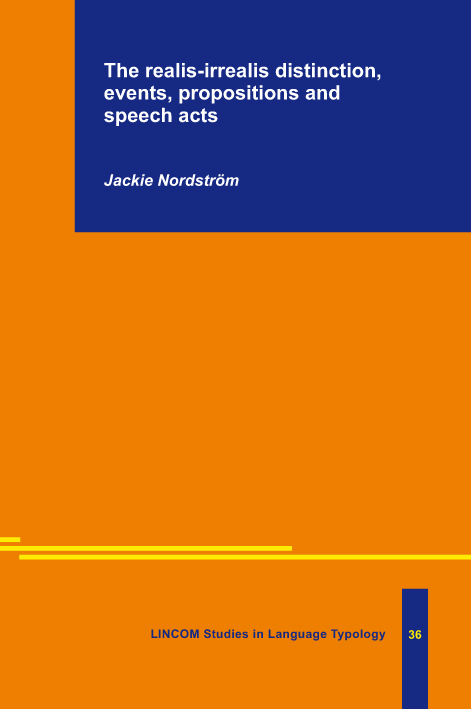
Jackie Nordström: The realis-irrealis distinction, events, propositions and speech acts
ISBN 9783969392676 (Hardbound). LINCOM Studies in Language Typology 36. 132pp. 2025.
This book shows through an extensive cross-linguistic investigation of 1051 languages that there are at least three distinct functions associated with the binary realis-irrealisdistinction in the languages of the world, one more common one denoting event status (as in Elliot [2000], Foley and van Valin [1984]), another less common one denotingpropositional modality (as in Givón [1994], Nordström [2010]) and a third, rare one involving speech act modality (as in Bybee and Fleichmann [1995], Palmer [2001]).
The first function has merely scope over the event, involving categories such as the plain future and event modality, but not propositional modality, whereas the second one has scope over the proposition, involving categories such as propositional modality but typically not the plain future. The third one involves the distinction between assertion vs. non-assertion. The division is supported by the findings that realis-irrealis markers denoting event status are morpho-syntactically less peripheral than realis-irrealis markers denoting propositional modality and that complement clauses introduced by event status realis-irrealis markers are more deranked than complement clauses introduced by propositional modal ones. As a consequence, one can never find a single unifying feature for all language-specific realis-irrealis distinctions, as opposed to what has been argued in previous accounts.
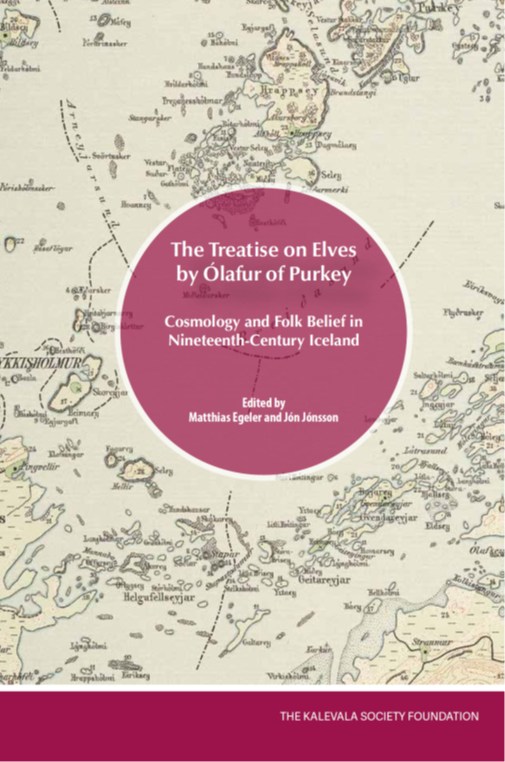
Matthias Egeler; Jón Jónsson: The Treatise on Elves by Ólafur of Purkey: Cosmology and Folk Belief in Nineteenth-Century Iceland. (=Folklore Fellows’ Communications 330), Helsinki: Kalevala Society Foundation 2026.
https://tiedekirja.fi/fi/treatise-on-elves-by-olafur-of-purkey
In the
years around 1830, the lcelandic farmer, fisherman, and scribe Ólafur Sveinsson
(1761-1845) set out to prove the existence of the 'hidden people' (huldufólk)
or 'elves' (álfar), which he experienced as an everyday part of his life as a
man working the land and the sea. ln order to achieve his aim, he collected
memorates, traditional tales, poems, and literary references, focusing on his
extended family, neighbours, and acquaintances especially in the fjord of
Breiðafjöður in Western lceland. ln doing so, he compiled an ethnography of
local traditions about elves, which stands out through its remarkable richness
of detail and an attention to context that makes it a testimony not only to
Ólafur's personal beliefs, but also to attitudes towards the 'hidden people' in
his wider local community. The resulting Treatise on Elves is perhaps the
single most detailed account of living folk belief as seen from the inside
perspective of a tradition bearer and believer to survive from the whole of
pre-industrial Europe.
This book presents the first edition and translation of Ólafur Sveinsson's
treatise on elves that makes its text accessible in the way how it was laid out
by Ólafur himself. The text is accompanied by an analysis of its social,
literary, and economic context that shows the rich contributions which Ólafur’s
unique testimony can make to our understanding of the workings of
pre-industrial folk belief in a sparsely settled North Atlantic landscape.
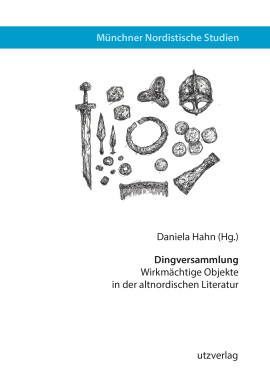
Katja Schulz: Mühlen zu Waffen statt Schwerter zu Pflugscharen. Eine dingfokussierte Betrachtung des Grotti-Mythos und seiner Kenningar. In: Daniela Hahn (Hsg.): Dingversammlung. Wirkmächtige Objekte in der altnordischen Literatur. München: Utzverlag 2025, S. 27-61.
Abstract: One prominent thing in Old Norse literature is Grotti, a mill which has a plot-determining function in the Eddic poem which bears its name, Grottasǫngr. This article examines the mill from an object-oriented perspective to find answers to three questions: 1. Can the Grotti mill be understood as a nonhuman actant with own agency in the network around King Fróði? 2. Can the actor-network-theory help us to understand the nature of magic and its localization in the structure of action better? 3. What poetological and stylistic insights may be gained from an objectoriented consideration of Grottasǫngr and its transmission context? An examination of Grotti as an actant with its own agency reveals how human and nonhuman actants in the network at King Fróði's court influence one another and drive the plot forward. The magical dimension of the plot is to be understood as a relation between the actants rather than being attributed unilaterally to either the mill or the giantesses. Poetologically, analyzing Grotti as a thing can serve to illustrate the role objects play in the construction and interpretation of kennings: The kenning as an at least bipartite replacement of a noun (base-word plus determinant) is always based on a change of reference of the base word, which often denotes a material object. In this way, tropical kennings (metaphor, synecdoche and metonymy) introduce additional associations, pre-semantizations or intertextual references into a poem. Explaining this is the project of the Snorra Edda, in whose context the Grottasǫngr has been handed down. The song itself is a narrative unfolding of kennings, which connect the myth of the mill with two, ultimately incompatible references to this thing: the gold kenning ›meal of Fróði‹ and the kenning ›man-hostile Grotti [hand-mill] of the skerries‹, which probably refers to a grinding current in the sea.
Das Kapitel kann hier eingesehen werden.
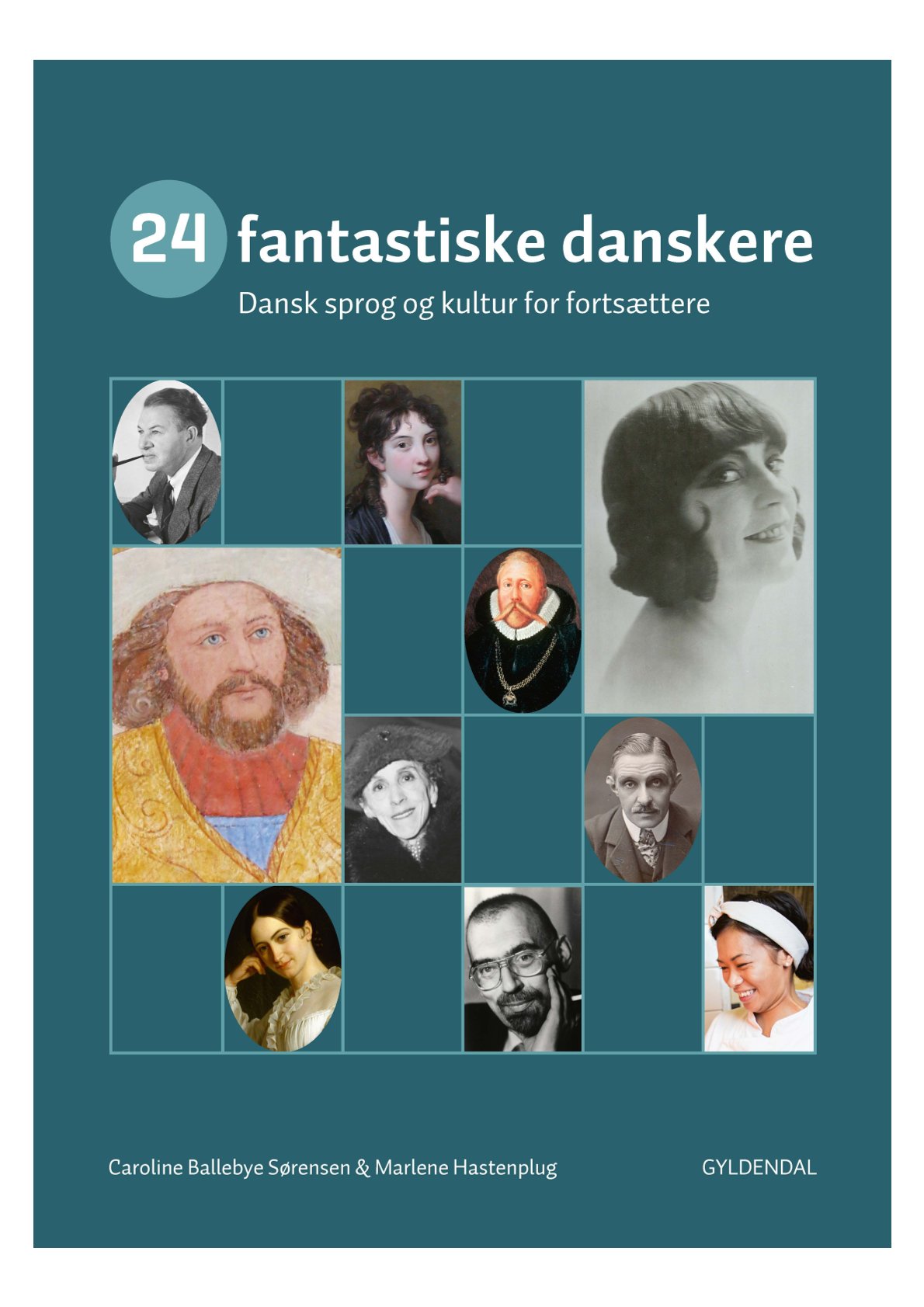
Marlene Hastenplug und Caroline Balleby Sørensen
24 fantastiske danskere
Gyldendal 2024, København, Dänemark
160 Seiten
Das Lehrbuch 24 fantastiske danskere (B1-B2) von Caroline Ballebye Sørensen und Marlene Hastenplug ist für alle Fortgeschrittenen gedacht, die nicht nur Dänisch lernen, sondern auch mehr über die Kultur und Geschichte Dänemarks erfahren möchten, zum Beispiel Studierende an Universitäten außerhalb des Landes.
In 12 Kapiteln werden jeweils zwei interessante Däninnen und Dänen und ihre Zeitgenossen vorgestellt - von König Harald Blåtand bis zum Küchenchef Dak Wichangoen. Das Historische wird mit der Gegenwart in Dialog gebracht und es werden ebenso viele interessante Frauen wie Männer vorgestellt. In allen Kapiteln steht neben der Lese- und Schreibkompetenz auch das Hören und Sprechen im Vordergrund.
Das Buch umfasst Übungen zu Grammatik, Hörverständnis und Konversation sowie Aussprachetraining, Rechercheaufgaben und Diskussionsfragen, an denen sich alle Kursteilnehmenden beteiligen können. In jedem Kapitel gibt es eine kreative Schreibübung, in der die Ausdrucksfähigkeit in verschiedenen Genres trainiert wird. Auf der Webseite des Buches finden sich neben allen Audiodateien auch Anregungen zur weiterführenden Lektüre in Form von Auszügen aus literarischen Texten, die sich auf die dargestellten Personen beziehen.
Dr. Caroline Ballebye Sørensen ist Lehrbeauftragte für Dänisch an den Universitäten Zürich und Basel; Marlene Hastenplug ist Lektorin für Dänisch am Institut für Skandinavistik an der Goethe-Universität Frankfurt.
Frederike Felcht, Søren Frank and Katie Ritson: The Sea in Nordic Literature. Oceanic
Criticism and Blue Humanties, London: Routledge 2026.
The first collection to address the role of the oceanic in literary texts and traditions from across the Nordic region, this book explores applications of ecocriticism, postcolonial theory, new materialism, and gender studies at a time when interest in marine ecosystems and their vulnerabilities to anthropogenic climate change is generating new theoretical insights and interest across the humanities.
The Nordic countries with their long coastlines and archipelagic geographies have long histories of seafaring and mariculture. This book simultaneously introduces Nordic literatures about the sea to international scholars with an interest in the oceanic and blue humanities to scholars working within Scandinavian/Nordic Studies.
Jackie Nordström: The realis-irrealis distinction, events, propositions and speech acts
ISBN 9783969392676 (Hardbound). LINCOM Studies in Language Typology 36. 132pp. 2025.
This book shows through an extensive cross-linguistic investigation of 1051 languages that there are at least three distinct functions associated with the binary realis-irrealisdistinction in the languages of the world, one more common one denoting event status (as in Elliot [2000], Foley and van Valin [1984]), another less common one denotingpropositional modality (as in Givón [1994], Nordström [2010]) and a third, rare one involving speech act modality (as in Bybee and Fleichmann [1995], Palmer [2001]).
The first function has merely scope over the event, involving categories such as the plain future and event modality, but not propositional modality, whereas the second one has scope over the proposition, involving categories such as propositional modality but typically not the plain future. The third one involves the distinction between assertion vs. non-assertion. The division is supported by the findings that realis-irrealis markers denoting event status are morpho-syntactically less peripheral than realis-irrealis markers denoting propositional modality and that complement clauses introduced by event status realis-irrealis markers are more deranked than complement clauses introduced by propositional modal ones. As a consequence, one can never find a single unifying feature for all language-specific realis-irrealis distinctions, as opposed to what has been argued in previous accounts.
Matthias Egeler; Jón Jónsson: The Treatise on Elves by Ólafur of Purkey: Cosmology and Folk Belief in Nineteenth-Century Iceland. (=Folklore Fellows’ Communications 330), Helsinki: Kalevala Society Foundation 2026.
https://tiedekirja.fi/fi/treatise-on-elves-by-olafur-of-purkey
In the
years around 1830, the lcelandic farmer, fisherman, and scribe Ólafur Sveinsson
(1761-1845) set out to prove the existence of the 'hidden people' (huldufólk)
or 'elves' (álfar), which he experienced as an everyday part of his life as a
man working the land and the sea. ln order to achieve his aim, he collected
memorates, traditional tales, poems, and literary references, focusing on his
extended family, neighbours, and acquaintances especially in the fjord of
Breiðafjöður in Western lceland. ln doing so, he compiled an ethnography of
local traditions about elves, which stands out through its remarkable richness
of detail and an attention to context that makes it a testimony not only to
Ólafur's personal beliefs, but also to attitudes towards the 'hidden people' in
his wider local community. The resulting Treatise on Elves is perhaps the
single most detailed account of living folk belief as seen from the inside
perspective of a tradition bearer and believer to survive from the whole of
pre-industrial Europe.
This book presents the first edition and translation of Ólafur Sveinsson's
treatise on elves that makes its text accessible in the way how it was laid out
by Ólafur himself. The text is accompanied by an analysis of its social,
literary, and economic context that shows the rich contributions which Ólafur’s
unique testimony can make to our understanding of the workings of
pre-industrial folk belief in a sparsely settled North Atlantic landscape.
Katja Schulz: Mühlen zu Waffen statt Schwerter zu Pflugscharen. Eine dingfokussierte Betrachtung des Grotti-Mythos und seiner Kenningar. In: Daniela Hahn (Hsg.): Dingversammlung. Wirkmächtige Objekte in der altnordischen Literatur. München: Utzverlag 2025, S. 27-61.
Abstract: One prominent thing in Old Norse literature is Grotti, a mill which has a plot-determining function in the Eddic poem which bears its name, Grottasǫngr. This article examines the mill from an object-oriented perspective to find answers to three questions: 1. Can the Grotti mill be understood as a nonhuman actant with own agency in the network around King Fróði? 2. Can the actor-network-theory help us to understand the nature of magic and its localization in the structure of action better? 3. What poetological and stylistic insights may be gained from an objectoriented consideration of Grottasǫngr and its transmission context? An examination of Grotti as an actant with its own agency reveals how human and nonhuman actants in the network at King Fróði's court influence one another and drive the plot forward. The magical dimension of the plot is to be understood as a relation between the actants rather than being attributed unilaterally to either the mill or the giantesses. Poetologically, analyzing Grotti as a thing can serve to illustrate the role objects play in the construction and interpretation of kennings: The kenning as an at least bipartite replacement of a noun (base-word plus determinant) is always based on a change of reference of the base word, which often denotes a material object. In this way, tropical kennings (metaphor, synecdoche and metonymy) introduce additional associations, pre-semantizations or intertextual references into a poem. Explaining this is the project of the Snorra Edda, in whose context the Grottasǫngr has been handed down. The song itself is a narrative unfolding of kennings, which connect the myth of the mill with two, ultimately incompatible references to this thing: the gold kenning ›meal of Fróði‹ and the kenning ›man-hostile Grotti [hand-mill] of the skerries‹, which probably refers to a grinding current in the sea.
Das Kapitel kann hier eingesehen werden.
Marlene Hastenplug und Caroline Balleby Sørensen
24 fantastiske danskere
Gyldendal 2024, København, Dänemark
160 Seiten
Das Lehrbuch 24 fantastiske danskere (B1-B2) von Caroline Ballebye Sørensen und Marlene Hastenplug ist für alle Fortgeschrittenen gedacht, die nicht nur Dänisch lernen, sondern auch mehr über die Kultur und Geschichte Dänemarks erfahren möchten, zum Beispiel Studierende an Universitäten außerhalb des Landes.
In 12 Kapiteln werden jeweils zwei interessante Däninnen und Dänen und ihre Zeitgenossen vorgestellt - von König Harald Blåtand bis zum Küchenchef Dak Wichangoen. Das Historische wird mit der Gegenwart in Dialog gebracht und es werden ebenso viele interessante Frauen wie Männer vorgestellt. In allen Kapiteln steht neben der Lese- und Schreibkompetenz auch das Hören und Sprechen im Vordergrund.
Das Buch umfasst Übungen zu Grammatik, Hörverständnis und Konversation sowie Aussprachetraining, Rechercheaufgaben und Diskussionsfragen, an denen sich alle Kursteilnehmenden beteiligen können. In jedem Kapitel gibt es eine kreative Schreibübung, in der die Ausdrucksfähigkeit in verschiedenen Genres trainiert wird. Auf der Webseite des Buches finden sich neben allen Audiodateien auch Anregungen zur weiterführenden Lektüre in Form von Auszügen aus literarischen Texten, die sich auf die dargestellten Personen beziehen.
Dr. Caroline Ballebye Sørensen ist Lehrbeauftragte für Dänisch an den Universitäten Zürich und Basel; Marlene Hastenplug ist Lektorin für Dänisch am Institut für Skandinavistik an der Goethe-Universität Frankfurt.